
What Actually Works: Honest Modern Addition
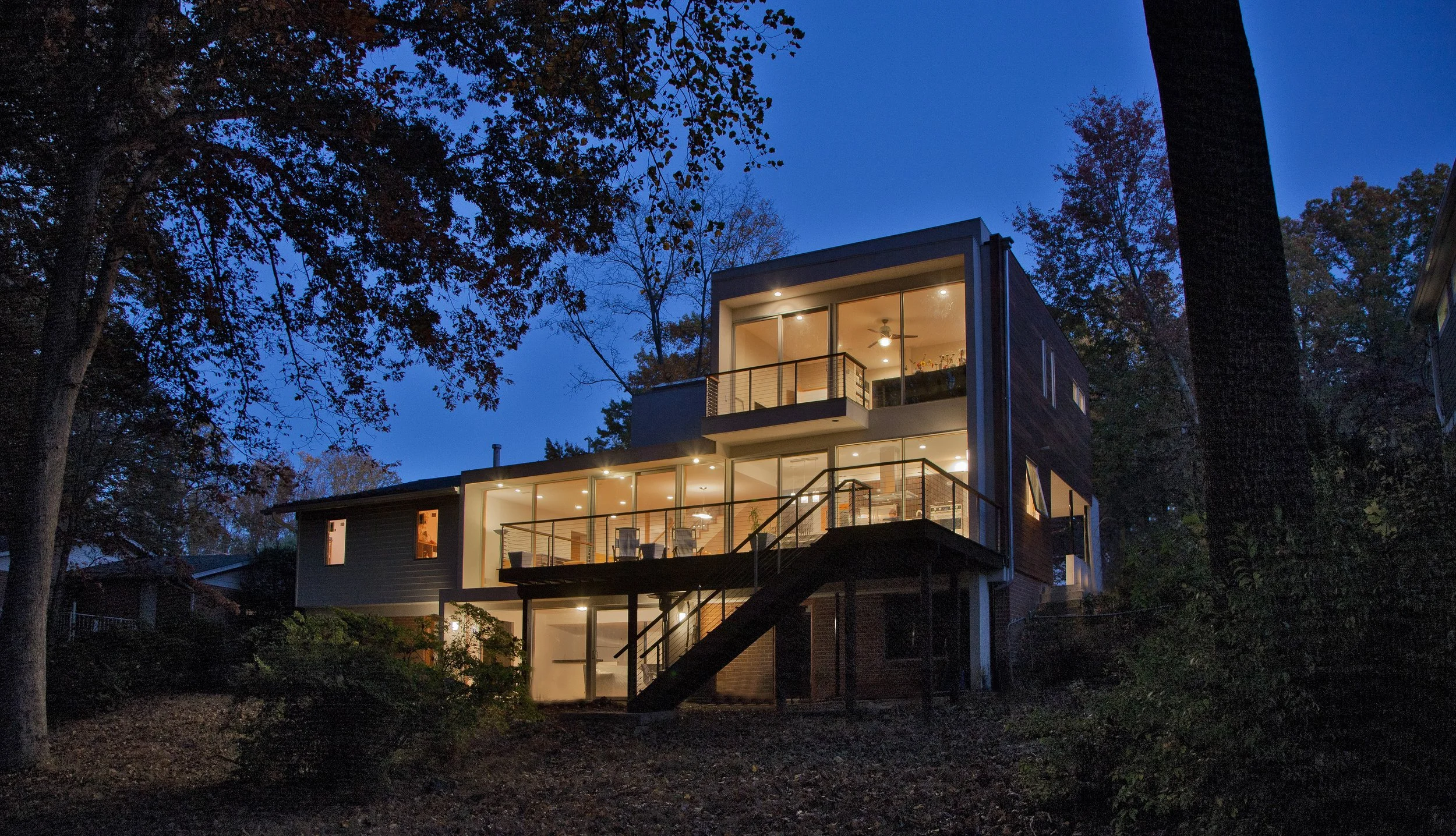
Modern home addition in North Bethesda designed by RT Studio
You want to add space to your house.
So you start looking at what other people have done.
And you notice something: everyone tries to match their existing house.
Same siding. Same roofline. Same windows.
Like the goal is to fool people into thinking the addition was always there.
Here's what no one tells you: matching rarely works.
And even when it does, it's the expensive way to do it wrong.
Why Matching Doesn't Work
Materials Change
That brick on your 1985 colonial? They don't make it anymore.
The manufacturer changed the formula. The clay comes from a different quarry. The firing process is different.
You can get "close" - but close isn't the same.
And close looks worse than different.
Your eye notices the mismatch. It looks like you tried and failed.
Better: Use a complementary material that's clearly intentional.
Building Codes Change
Your existing house was built to 1985 codes.
Your addition needs to meet 2025 codes.
That means:
Different window sizes (energy code requirements)
Different framing (updated structural requirements)
Different insulation (R-value minimums)
Different ceiling heights (accessibility standards in some cases)
You can't actually build it the same way even if you wanted to.
Proportions Get Weird
Your existing house has 8-foot ceilings.
Modern additions look better with 9-foot ceilings.
Now your roofline doesn't align. The windows don't line up. The whole thing looks awkward.
The choice:
Force it to match and make your new space feel cramped
Accept that old and new are different
It's More Expensive
Matching costs money:
Custom brick matching: +$15-25/sq ft Custom millwork to match old trim: +$8-15/sq ft
Searching for discontinued materials: Weeks of delays Trial and error on finishes: Change orders and frustration
You're paying extra to make something look like it's trying to hide.
What Actually Works for Modern Additions
Be Clear About What's New
Modern addition. Traditional house. Both honest about what they are.
The modern part brings:
More natural light (bigger windows, better placement)
Better flow (open to existing spaces)
Contemporary convenience (the spaces you actually need now)
Energy efficiency (built to modern standards)
The traditional part keeps:
The character you loved
The street presence
The neighborhood context
The reason you didn't move
Together they're more interesting than either alone.
Use Complementary Materials
Don't try to match your 1970s brick.
Bethesda and North Bethesda colonials often reveal structural inconsistencies once walls are opened, which makes matching even harder.
Instead:
Clean fiber cement siding in a complementary color
Wood siding that contrasts intentionally
Black metal panels that clearly say "new"
Large windows that modern detailing requires
The materials should be high-quality and timeless, but contemporary.
Create Intentional Transitions
Where old meets new should be celebrated, not hidden. Rockville and Silver Spring homes on R‑60 lots often can’t align rooflines without compromising ceiling height.
A glass connector between original house and addition:
Brings light into the old house
Makes the distinction clear
Creates a special moment
Costs less than trying to match rooflines
A recessed connector:
Keeps the addition from overpowering the original
Provides a visual break
Often solves roof drainage issues
Gives you a covered outdoor space
Modern Details Cost Less
In Montgomery County, inspectors often prefer modern detailing because it avoids the ambiguity of trying to replicate outdated construction methods.
We’ve had modern additions approved in Bethesda, Chevy Chase, and Takoma Park because the design was honest rather than imitative.Traditional addition trying to match:
Custom trim profiles: $12-18/linear foot
Matching crown molding: $8-15/linear foot
Matching window muntins: $200-400 per window upcharge
Corbels, brackets, dentil molding: $$$
Modern addition:
Clean reveals: standard framing
Minimal trim: $3-6/linear foot
No applied ornament: eliminated cost
Simple details done well: less labor
You save $20-40/sq ft on finishes alone.
Real Examples from Our Projects
Example 1: 1960s Ranch in Rockville
The house: Single-story brick ranch, 1,800 sq ft
What they needed: 600 sq ft for kitchen expansion and family room
What we did:
Modern addition with floor-to-ceiling windows
Fiber cement siding in charcoal gray (complements brick)
Flat roof with deep overhang
Glass corner at transition between old and new
The result:
Addition clearly modern
Doesn't fight the original house
Brought light into the existing dark kitchen
Cost $225K vs. $280K to match brick and roofline
Example 2: 1980s Colonial in Bethesda
The house: Two-story colonial, vinyl siding, 2,400 sq ft
What they needed: 500 sq ft master suite addition
What we did:
Two-story modern volume attached to side
Natural wood siding (cedar)
Large windows on private side
Simple shed roof
The result:
Addition became the architectural highlight
Original house looks better by contrast
Passed historic district review (because it's honest, not fake-historical)
Cost $240K vs. $300K+ to match vinyl and colonial details
Example 3: 1950s Cape Cod in North Bethesda
The house: 1.5-story Cape Cod, 1,600 sq ft
What they needed: 700 sq ft first floor expansion
What we did:
Modern single-story addition
Recessed from front façade
Large sliding doors to backyard
Metal standing seam roof
The result:
Cape Cod maintains street presence
Addition creates indoor-outdoor connection they never had
Clearly two different eras, both done well
Cost $265K vs. $340K to add dormers and match Cape details
The Architecture Community Agrees
Look at any architectural magazine.
The best additions don't try to match.
They're respectful modern interventions that make both old and new better.
Historic preservation boards are coming around too.
We've gotten modern additions approved in:
Bethesda historic districts
Chevy Chase
Takoma Park
The key: high-quality modern design that respects scale and context without mimicking historical details.
When Matching Might Make Sense
We’ve had modern additions approved in Bethesda, Chevy Chase, and Takoma Park because the design was honest rather than imitative. Montgomery County’s historic preservation guidelines emphasize clear differentiation between old and new, even in designated historic districts.
Historic Homes (Pre-1940)
If your house is architecturally significant, matching might be required.
But even then, preservation guidelines often prefer:
Clearly differentiated additions
Reversible interventions
Honest contemporary work
Formal Symmetry
If you're filling in a missing wing on a symmetrical Georgian, you might need to match.
But most suburban houses aren't formal compositions.
Small Bump-Outs
For a 50 sq ft bump-out, matching might make sense because the addition is negligible.
But at 200+ sq ft, embrace the addition as its own element.
What Makes a Modern Addition Work
1. Quality Over Imitation
Use real materials:
Real wood, not vinyl
Real metal, not plastic
Real fiber cement, not cheap composites
Quality modern materials age better than cheap traditional replicas.
2. Respect Scale and Proportion
The addition shouldn't overpower the original.
Set back from the front façade
Lower roofline than main house (if single story)
Appropriate size relative to existing
3. Create Connection
Between old and new:
Shared sightlines
Flow between spaces
Light borrowed from new into old
Unified color palette inside
4. Design for How You Live Now
The addition should serve your current needs:
Open kitchen to family room
Mudroom by the actual entrance you use
Home office with door
Master suite on first floor
Don't add historical rooms you don't need just to match.
The Modern Addition Advantage
More Natural Light
Modern design prioritizes windows and light.
Your addition brings light into your existing dark house.
Try doing that while matching your 1980s colonial with its small windows.
Better Energy Performance
Modern additions are built to 2025 energy codes.
High-performance windows, better insulation, air sealing.
Your addition performs better than your existing house - and can improve it.
Easier Permitting
Modern additions that are clearly additions often permit faster. This is especially true in Montgomery County, where clarity between old and new reduces review friction.
No debates about historical accuracy.
No trying to prove your fake historical details are appropriate.
Ages Better
In 20 years:
Your "matching" addition will look dated because:
The materials will have aged differently
The details will never quite be right
It will be clear it's not original
Your modern addition will still look intentional because:
It never pretended to be old
Quality modern materials age well
The honesty reads as design integrity
Common Concerns Addressed
"Won't a modern addition hurt resale value?"
No. Well-designed modern additions in our market:
Sell faster than poorly matched additions
Appeal to buyers who want both character and function
Show quality and thoughtfulness
Photograph better for listings
"What will my neighbors think?"
Initially? Some might be skeptical.
After it's built? They'll ask for your architect's number.
We've seen this repeatedly. The modern addition becomes the best-looking house on the block.
"Will it look weird?"
Only if it's designed poorly.
Good modern additions:
Respect the existing house
Use high-quality materials
Are proportioned correctly
Are detailed carefully
This requires an architect who understands both modern and traditional architecture.
"Isn't this just a trend?"
Good modern architecture isn't trendy.
It's timeless principles applied to contemporary needs:
Honest use of materials
Functional spaces
Connection to light and nature
Appropriate to its time
These don't go out of style.
Our Approach
When you come to us wanting to add space:
We don't automatically assume modern is right.
We look at:
Your existing house (is it architecturally significant?)
Your neighborhood (what's appropriate in context?)
Your needs (what actually works for your life?)
Your budget (what's realistic?)
But we've found over 12 years:
Modern additions almost always:
Cost less
Function better
Look more intentional
Age better
Make clients happier
Than trying to match.
See our Additions & Whole‑Home Transformations to understand how we approach these projects.
Get Honest Advice for Your House
Every house is different.
Maybe yours is the rare case where matching makes sense.
But probably not.
Book a Modern Vision Assessment: $1,500 (Fully credited toward design fees)
We'll analyze YOUR house and give you honest recommendations:
Whether modern or matching is appropriate
What will work with your existing architecture
What it will cost
What will get approved in your jurisdiction
No pressure to do it our way. Just honest advice.
Call: 301.922.4152
Email:info@rtarchstudio.com
Website: rtarchstudio.com
We only take 5 new clients per quarter.
Serving Montgomery County, Maryland and Northern Virginia since 2013.