
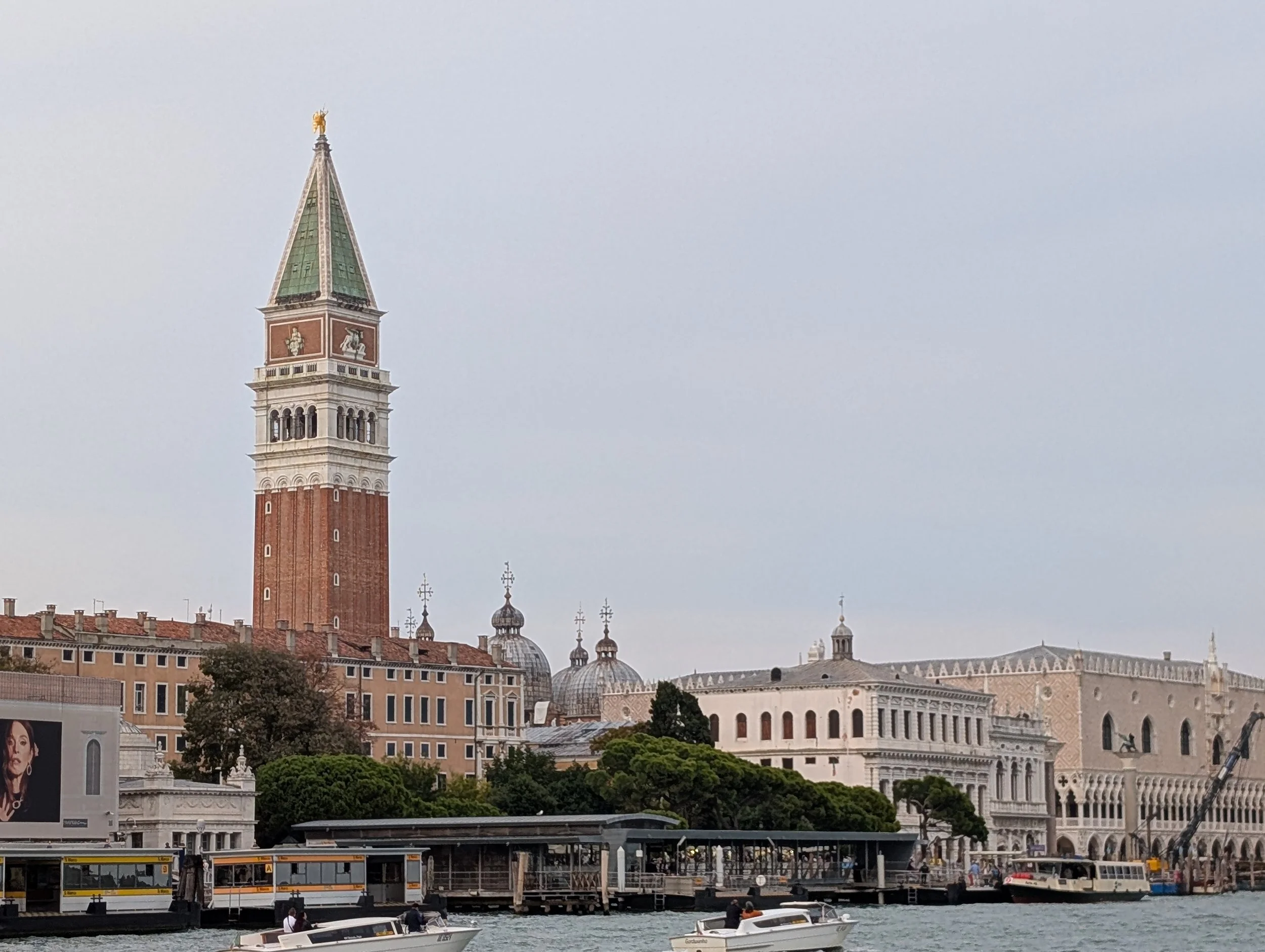
Venice, Italy.
Every style that feels traditional today was once someone's idea of the future.
When homeowners in the DMV face the choice between modern and traditional home design, most reach for traditional without thinking too hard about why. The answer, I think, is nostalgia — and it is worth understanding before you decide what to build.
The Colonial house was not handed down from antiquity. It was built by people who were making decisions about materials, proportion, and form with what they had, in their moment, for their lives. The Craftsman bungalow was a reaction against Victorian excess — a modernist argument, in its time, for honesty of material and simplicity of form. Mid-century modern was so controversial when it arrived that entire neighborhoods fought to keep it out.
Each of these styles became traditional the same way: time passed, the culture absorbed them, and what was once unfamiliar became the furniture of memory. We grew up around them. They became what home looks like.
So here is the question worth asking: if we know that every generation's modern becomes the next generation's traditional, why do so many homeowners today reach backward instead of forward? Why, given a choice, do people commission copies of styles that were themselves once radical — rather than something that is genuinely of this moment?
The answer, I think, is nostalgia. And nostalgia is worth taking seriously before you dismiss it.
What nostalgia is actually doing
Nostalgia is not really about the past. It is about a feeling the past contained.
When a homeowner says they want a traditional house — the front porch, the pitched roof, the divided-light windows — they are not asking for a history lesson. They are asking for something that feels like safety, like belonging, like the kind of place where a family settles and stays. They are asking for warmth. For permanence. For a house that feels like it has always been there and always will be.
Those are legitimate things to want. They are, in fact, exactly what a home should provide.
The problem is not the desire. It is the assumption that the style is what delivers it.
The front porch does not feel like home because of its architectural lineage. It feels like home because it is a threshold between private and public, a place to exist between inside and outside, a space that belongs to the family but faces the street. The warmth of a Craftsman living room does not come from the trim details. It comes from the ceiling height, the fireplace as anchor, the way the room holds the people in it.
These are spatial qualities. And spatial qualities are not owned by any style.
What traditional home design promises — and what it delivers
Traditional architecture has been very good at one thing: making the promise of that feeling legible. The pitched roof reads as shelter. The symmetrical facade reads as stability. The porch reads as welcome. These are powerful signals, and they work before you have even opened the door.
But a signal is not the same as the thing itself.
A house can have every traditional element — the columns, the shutters, the dormers — and feel hollow inside. Rooms that do not connect to each other or to the outside. Ceiling heights calibrated to minimize cost rather than maximize the experience of living. Light that enters without intention, landing on surfaces without purpose. A floor plan assembled from a catalog rather than designed for a family.
The signal said warmth. The experience did not deliver it.
This is the gap that nostalgia opens. We reach for the familiar because the familiar has promised us something — and because modern architecture, in many people's experience, has not made that promise clearly enough. The glass box does not say shelter. The flat roof does not say permanence. The absence of ornament does not say welcome.
Modern architecture has a legibility problem. And it is worth admitting that before making the case for it.
What modern architecture is actually offering
The best modern houses are not trying to be cold. They are trying to be honest.
Honest about materials — what a thing is made of is visible, not concealed behind surfaces that pretend to be something else. Honest about structure — the way a building stands is part of how it looks. Honest about light — where the sun is, how it moves through the day, how a room can be designed to hold morning differently than evening. Honest about how a family actually lives — not the formal parlor and the servants' entrance, but the kitchen as the center of the house, the connection between inside and outside, the ceiling that rises where you gather and settles where you sleep.
These are not aesthetic preferences. They are design principles. And when they are applied with care, they produce spaces that feel exactly what homeowners say they are looking for when they reach for traditional: warm, grounded, specific to the people who live in them.
The difference is that modern architecture earns those qualities through design rather than borrowing them through reference. It does not say this feels like home because it looks like the homes you remember. It says this feels like home because it was designed for your life, on your site, in your moment.
That is a harder promise to make legible. It requires more trust. And it requires a designer willing to make the argument clearly enough that the client can follow it.
What Italy taught me about nostalgia
I was in Italy recently. If any place has earned the right to be nostalgic about its architecture, it is Italy. The Pantheon. The hill towns of Tuscany. Streets where every surface has been there longer than the country I live in has existed.
And yet when Italian architects build something new, they almost never try to copy what surrounds it. A contemporary building sits next to a Renaissance palace and makes no apology for being of its own time. The old is preserved because it is old and irreplaceable. The new is built as new — with its own materials, its own logic, its own relationship to light and structure and the way people live now.
Nobody in Rome is building fake columns on a spec house to make it feel historic. The history is already there. What they are building is what comes next.
We do not have that history. What we have instead is nostalgia — a longing for the feeling of permanence and belonging that old places carry. And so we build copies. We put columns on houses that have no structural reason for columns. We add shutters that do not shut. We pitch roofs not because the climate demands it but because a pitched roof signals home.
The Italians would find this strange. Not because they do not love their old buildings — they clearly do, with a devotion that shapes the entire culture. But because they understand something we have not yet absorbed: you honor the past by building the present well, not by imitating it.
The real choice between modern and traditional home design
If you are building or renovating a home, you are not really choosing between modern and traditional. You are choosing between two different answers to the same question: what makes a house feel like home?
One answer borrows that feeling from the past — from styles that have already proven they can carry it, that have been absorbed into the culture as signals of exactly what you are looking for. It is a reasonable answer. It has worked before. It will probably work again.
The other answer builds that feeling from scratch — from the specific conditions of your site, your family, your life, and your moment. It does not arrive with the signal already attached. It has to earn the feeling through the design itself.
That second answer is harder. It requires more from the designer and more from the client. But it produces something the first answer cannot: a house that is genuinely yours. Not a copy of something that was once original — something that is original now.
Nostalgia is a powerful force. It points toward something real. But what it is pointing toward is not a style. It is a feeling. And that feeling is available in the present tense, if you are willing to build toward it rather than back toward it.
At RT Studio, every project begins with that question — what does home actually feel like for this family, on this site, right now — and works forward from there. We show you the entire project in 3D and virtual reality before anything is built, so the feeling is not a promise. It is something you can see and decide before a single wall goes up.
If you are ready to build toward what you are actually looking for — that conversation starts here.
→ Book a consultation at rtarchstudio.com