
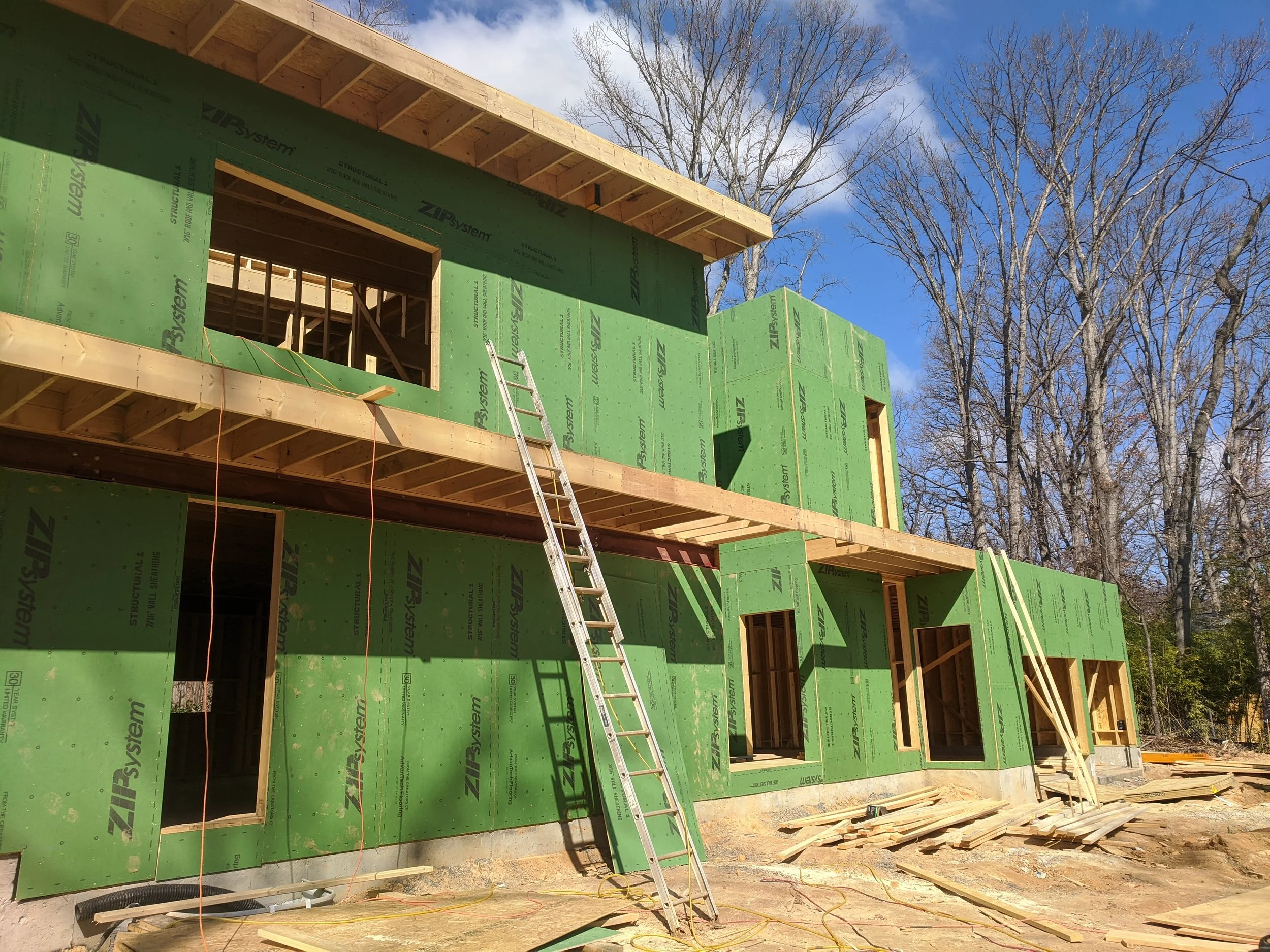
The question comes up in almost every project, at almost every stage.
Why is this taking so long? Can we move faster? What would it take to get this done sooner?
How long does a home project actually take in the DMV — whether a renovation, an addition, or a new build? Long enough that most clients are surprised — and the reasons have very little to do with how hard anyone is working. The gap between deciding to build and actually building — design, permitting, contractor selection, construction — is real time, with real structure to it. Of course people want it to be shorter.
But the question almost always contains a hidden assumption: that the timeline is a dial someone is choosing not to turn. That if the designer worked faster, or the contractor started sooner, or the permits moved more quickly, the project would compress accordingly.
It does not work that way. And understanding why is the clearest path to a project that actually finishes when you need it to.
Why residential projects take longer than you expect
A renovation, addition, or new construction project moves through a sequence that cannot be meaningfully compressed.
Design has to happen before drawings. Drawings have to happen before permits. Permits have to happen before construction. And at each stage, the work of the previous stage has to be complete enough to support the next one. You cannot get a contractor's real number without drawings. You cannot get drawings without a design. You cannot get a design without understanding the project — the site, the structure, the family, the scope.
Each of these stages takes the time it takes. Not because anyone is moving slowly, but because the decisions being made are real decisions with real consequences, and real decisions require the information that produces them.
Skipping steps does not eliminate them. It moves them into a later stage where they cost more to resolve. The design question that gets deferred becomes a field decision during construction. The field decision costs more than the design decision it replaces — in money, in time, and in the quality of the outcome.
Permitting in the DMV is not in anyone's control
Permitting is the stage that surprises people most.
In the DMV, permit review timelines are set by the jurisdiction, not by the applicant. A complete, well-prepared submission helps. It does not eliminate the wait. Some jurisdictions move in weeks. Others take months. That clock starts when the submission is complete — and it does not run faster because the client needs to be in the house by a certain date.
A well-prepared set of drawings reduces the chance of a revision cycle, which is where real time gets lost. An incomplete or unclear submission comes back with comments, and every revision round adds weeks to the clock. This is one of the places where the design process pays for itself — drawings that are thorough and clear before they are submitted move through review faster than drawings that were rushed to get to the permit counter.
But even a perfect submission is at the mercy of the review queue. That is not a problem anyone can design around.
What most clients also do not know is that building permits are often not the only permits required. Depending on the project and the jurisdiction, civil permits — for grading, stormwater management, erosion and sediment control, or utility connections — may be required separately, through a different agency, on a different review cycle. Civil permits in the DMV can take six months or more, and that clock runs independently of the building permit. A project that has its building permit in hand but is still waiting on civil approvals cannot break ground. These are not edge cases. They come up regularly on additions and new homes, and they need to be identified and applied for early — not discovered when the contractor is ready to mobilize.
The best contractors are not available immediately
Contractors compound the timeline further — in a way that most clients do not anticipate.
The best contractors — the ones with the experience to execute a modern project correctly, with the relationships and the craft that the work requires — are booked. Sometimes months out. They are booked because they are good, and because good contractors are always in demand.
The contractor who can start next week is available for a reason. That reason is usually not one you want to inherit.
This means that contractor selection cannot be treated as the last step. It needs to happen in parallel with the later stages of design, so that by the time drawings are complete and permits are in review, a contractor is already committed and scheduled. The clients who treat contractor selection as something to figure out after the drawings are done often discover that the contractors they want cannot start for another six months.
The most expensive delay is the one that comes from inside
There is one more source of timeline extension that nobody likes to name — but that comes up more than any of the others.
Clients change their minds.
Not because they are difficult. Because design decisions that felt abstract on paper become concrete when walls go up, and what seemed right in a drawing does not always feel right in a space. A window moves. A room gets rethought. A finish material that was specified months ago gets reconsidered when the client sees it next to everything else.
Every one of these changes has a cost — in money, and in time. A change that happens during the design process costs almost nothing. The same change made during construction can cost weeks and significant dollars: drawings get revised, permits may need amendment, work already done gets undone, materials already ordered sit in a warehouse or get returned at a loss.
This is not an argument against changing your mind. It is an argument for making decisions as early and as deliberately as possible — when changes are still on paper, still fast, still cheap. The design process exists, in part, to surface these decisions before construction begins. Clients who engage deeply with the design — who make real choices about real details while the project is still drawings — almost always have fewer changes in the field.
The clients who defer decisions, who want to see it built before they commit, who say they will figure it out later — they almost always figure it out later, in the most expensive way possible.
Materials, fabrication, and weather don't wait either
Once construction starts, the timeline encounters a new set of variables — and none of them are negotiable.
Materials have lead times. Some are predictable. Others are not. Custom windows, structural steel, certain cladding systems, cabinetry made to specification — these are not items you pick up at a supplier when you need them. They are ordered weeks or months in advance, fabricated to the drawings, and delivered when they are ready. A project that sequences correctly accounts for these lead times before the contractor mobilizes. A project that discovers them mid-construction waits.
Fabrication is its own timeline. A custom steel stair, a concrete countertop, a site-built element that requires shop drawings and approval before fabrication begins — each of these has a production schedule that runs in parallel with construction, and that schedule cannot be compressed at the end just because the rest of the project is ready for it.
Weather stops outdoor work. In the DMV, winter limits certain operations — concrete pours, exterior finishes, grading — and a project that hits these windows at the wrong moment waits for conditions that nobody can manufacture. A project that starts in October and plans to close the building envelope before winter needs to account for that sequence from the beginning, not discover it in December.
None of these are surprises to an experienced team. They are simply facts about how construction works — and they belong in the schedule from the first conversation, not as contingencies added after things have already slipped.
What actually controls the schedule
The projects that finish on time share a few things in common — and none of them are urgency.
They have a design that was completed before contractor pricing, so the numbers the contractors give are real numbers, not estimates based on incomplete information. They have permits that were applied for with complete, well-prepared drawings, so the review process starts on a solid foundation. And they have a contractor who was selected before construction started, not discovered during it.
What controls the schedule is clarity — at every stage, about what is being built and what comes next. Clarity is not something that happens automatically. It is something that gets produced, through the design process, before construction begins.
The clients who finish on time are the ones who invested in that clarity early. Not the ones who tried to skip it to save time.
What this means before you start
If you are considering an addition, a new home, or a renovation, the most useful question to ask before anything else is not "how fast can this be done?" It is "what does the sequence look like, and where does each stage actually start?"
The answer to that question tells you when to start the design process — which is almost always earlier than people expect. A project you want to break ground on in spring needs to be in design now. A project you want to complete by the end of next year needs permits in hand before summer.
The timeline is not a dial. But it is a map — and the clients who understand the map before the project starts are the ones who end up where they were trying to go.
At RT Studio, we walk through that map in the first conversation — before any commitment beyond a first meeting. We tell you honestly what the sequence looks like for your specific project, what the realistic timeline is, and what needs to happen and when to get there. We then show you the entire project in 3D and virtual reality before construction starts, so every decision is made with full information and nothing has to be resolved in the field.
If you want a project that finishes when it should — that conversation starts here.
→ Book a consultation at rtarchstudio.com