
Could Frank Lloyd Wright Build Today? And What His Answer Reveals About Great Residential Design
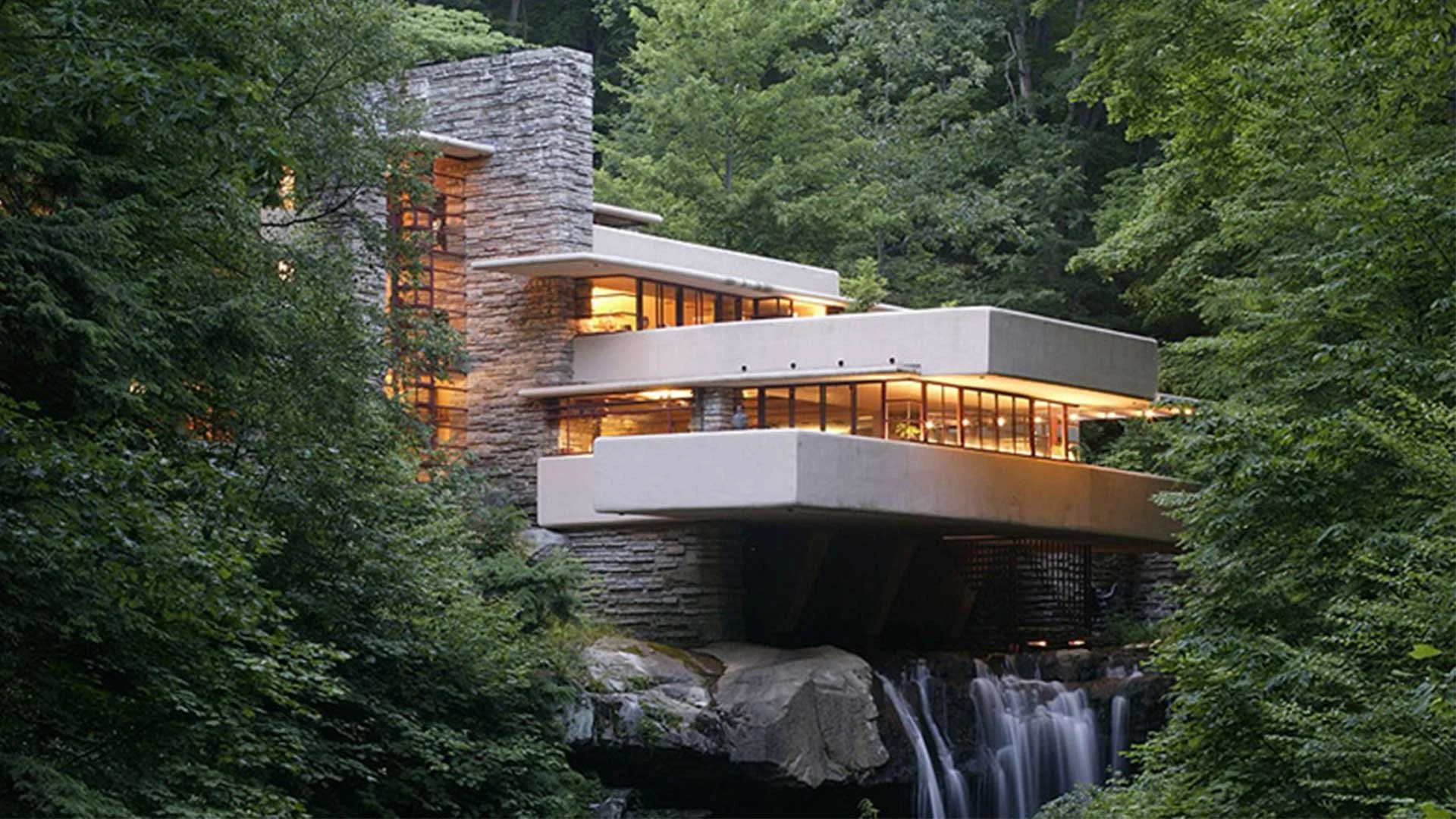
Fallingwater, Bear Run, PA, Frank Lloyd Wright - Architect
Why unforgettable architecture survives its imperfections — and why perfection alone never creates a home people love.
Fallingwater leaks.
It has always leaked. It leaked when it was built in 1939. It leaked when the Bear Run Nature Reserve spent over eleven million dollars restoring it in the early 2000s. The cantilevers deflect more than they should. The flat roofs — Wright’s signature — were never as waterproof as conventional pitched roofs. The clients who commissioned it, the Kaufmann family, had a complicated relationship with the man who designed it and the building that bore his genius.
Nobody cares.
Fallingwater is one of the most visited and most beloved buildings in the world. People travel from everywhere to stand on those cantilevered terraces above the waterfall and feel something that very few buildings ever produce — a sense that architecture can change the way you experience being alive.
The leaks are a footnote. The experience is the point.
But Fallingwater was never the whole story
Here is the part of Wright’s legacy that gets less attention than the drama of Fallingwater or the sweeping forms of the Guggenheim in New York.
In the late 1930s, at the same time he was designing one of the most famous houses in the world for a wealthy department store owner, Wright was also designing homes for ordinary American families. Teachers. Writers. Engineers. People who wanted to live well and could not afford the houses he was known for.
He called them Usonian houses. Concrete slab floors. Wood boards. Brick. No basements, no attics, no expensive finishes. Budgets that were tight not by choice but by necessity.
And they are extraordinary.
Not in spite of the constraints — because of them. The budget forced every decision to earn its place. The site determined the orientation. The ceiling height varied deliberately — low and intimate in the bedrooms, open and generous in the living spaces. The relationship between inside and outside was designed with the same obsessive care that went into Fallingwater, using materials that cost a fraction of what Fallingwater required.
Families who live in Usonian houses today describe them as the best spaces they have ever inhabited. Not because they are perfect — the flat roofs leaked there too — but because the thinking that went into them was extraordinary, regardless of what the budget allowed.
This is the argument that matters most for residential design: great design is not a function of budget. It is a function of conviction and care applied to the right problems. Wright proved it at Fallingwater. He proved it again, quietly and repeatedly, in modest houses built for families who could not afford to be famous clients.
Frank Gehry and the persistence of the argument
Frank Gehry has the same problem — and the same defense — as Wright.
His buildings are notoriously difficult to maintain. The titanium panels on the Guggenheim Bilbao move with temperature in ways that create ongoing challenges. His residential projects have been described by the people who live in them as beautiful and impractical in equal measure. The maintenance costs are real. The structural complexity is real. The gaps between what was designed and what can be perfectly executed are real.
And yet Bilbao changed a city. The building arrived in 1997 and within a decade had transformed a declining industrial port into one of the most visited destinations in Europe. The economic and cultural impact of one building — one leaky, expensive, structurally complex building — was so significant that urban planners coined a term for it: the Bilbao effect.
Great design, it turns out, does not have to be perfect. It has to be unforgettable.
Could Wright build today?
The honest answer is: not the way he built in the past. And the reasons are worth understanding.
Zoning envelopes would have constrained his site strategies. Building codes would have required structural calculations that challenged his more adventurous cantilevers. Energy codes would have demanded insulation values that conflict with his thin-shell concrete and single-pane glass. HOA rules would have rejected his flat roofs before the design was finished. The permitting process would have added months — sometimes years — to timelines he designed for a different era.
The contractor landscape would have presented its own challenges. Wright’s buildings required craftsmen who understood his specific demands — his custom brick modules, his precise material transitions, his insistence on detail that most construction workers of any era find maddening. Finding that level of craft today, at a price that most projects can support, is genuinely difficult.
And clients. Wright’s clients were remarkable people who gave him extraordinary latitude and paid for it in stress, cost overruns, and roofs that leaked on their furniture. The contemporary client — informed by HGTV, protected by contracts, advised by lawyers — would have ended the relationship before Fallingwater was half-built.
So no. Wright could not build exactly as he built. The system would not allow it.
But that is not really the question worth asking.
What Wright would keep
The system changes. The thinking doesn’t have to.
What Wright understood — what Gehry understands — is that architecture is not primarily about solving problems. It is about creating experiences. And the experience of a great building is worth more than the perfection of its execution.
He would keep the site obsession. The insistence on orienting a building to the sun, the landscape, the water, the view — on making the relationship between inside and outside the central act of the design. No zoning envelope changes that. No energy code prevents it.
He would keep the material honesty. The idea that what a building is made of should be visible — that brick should look like brick, wood like wood, concrete like concrete — is as relevant today as it was in 1939. Wright would not have survived the era of vinyl siding.
He would keep the spatial compression and release. The low entry that opens into a soaring living space. The intimate corridor that leads to the generous room. The deliberate manipulation of ceiling height to control how a body feels moving through a building.
He would keep the Usonian conviction. That a modest budget is not an excuse for modest thinking — and that families who cannot afford Fallingwater deserve the same quality of design attention as the ones who can.
And he would keep the insistence on specificity. That every project deserves to be designed from scratch — for this site, this family, this moment — rather than assembled from a catalog.
What this means for a home being designed today
The lesson from Wright and Gehry is not that imperfection is acceptable. It is that the pursuit of an extraordinary experience is worth the risk of imperfection — and that the alternative, the safe and competent and perfectly executed house that produces no feeling at all, is a worse failure than a leaking roof.
The spec box never leaks. It is built to code, maintained to standard, and produces exactly the experience you expect — which is to say, none in particular. It is the architectural equivalent of steamed broccoli: healthy, responsible, and impossible to remember. It satisfies every requirement except the one that matters most — the feeling of living in a space that was designed with intention rather than assembled from a checklist.
The homes that people love — that they talk about, that they stay in for decades, that their children remember — are almost never the ones that were executed perfectly. Perfection is safe. Safe is forgettable. They are the ones where someone made a decision bold enough to matter. Where the relationship between a room and a window was considered carefully enough to change how morning feels. Where the ceiling height was pushed just far enough to make the space feel generous in a way you cannot quite explain.
Those decisions involve risk. They require a designer willing to push beyond what is safe and a client willing to trust that the experience will be worth it. They do not require a Fallingwater budget. Wright proved that in every Usonian house he ever built.
What we do with it
At RT Studio we are not building Fallingwater. We are building homes for families in the DMV — with real budgets, real zoning constraints, real contractors, and real timelines.
But the conviction that every project deserves a bold decision — something that makes the house feel like it was designed for this family, on this site, in this moment — is the same conviction that drove Wright to cantilever a house over a waterfall and to design extraordinary spaces for families who could only afford concrete floors and wood boards.
We show you the entire project in 3D and virtual reality before anything is built. Not because we want to eliminate risk — but because we want you to understand exactly what you are choosing, and choose it with confidence.
Great design is not about perfection. It is not about budget. It is about intention. And intention, applied carefully to the right problems, produces homes that people love for the rest of their lives.
If you want a home that feels like it was designed for your life rather than assembled from a catalog — we would like to talk.
→ Book a consultation at rtarchstudio.com